What Is an Encryption Key? Types, Algorithms and Security
Encryption algorithms receive significant attention in cybersecurity discussions, but the keys that control those algorithms are what actually determine whether encryption protects your data. The strongest algorithm provides no security if the key is compromised, predictable, or poorly managed.
Understanding what makes keys secure, how different key types serve different purposes, and why key management is the critical vulnerability in most systems is essential for anyone responsible for protecting sensitive information. This guide covers the fundamentals of encryption keys, compares the major algorithms in use today, and addresses the emerging challenge of post-quantum cryptography.
What is an Encryption Key?
An encryption key is the secret parameter that controls an encryption algorithm's behaviour. The same algorithm applied with different keys produces completely different ciphertext, even from identical plaintext. The key is the sole element that must remain secret. Compromise of the key means compromise of all data encrypted with it.
Modern encryption keys are sequences of random bits. A 256-bit key is a random string of 256 zeros and ones, providing 2^256 possible key values. This is a number so large it exceeds the estimated number of atoms in the observable universe. This vast key space is what makes brute-force attacks impractical with current computing technology.
Symmetric and Asymmetric Keys: Two Approaches to Encryption
Encryption systems use two fundamentally different approaches to key management, each suited to different purposes.
Symmetric Keys
Symmetric encryption uses a single shared key for both encryption and decryption. Both the sender and recipient must possess the same secret key. This approach is fast and computationally efficient, making it the standard for bulk data protection: encrypting databases, file systems, network traffic, and stored data.
The dominant symmetric algorithm is AES (Advanced Encryption Standard), adopted by NIST in 2001 and now the global standard. AES supports key lengths of 128, 192, and 256 bits. AES-128 provides approximately 128 bits of security, meaning an attacker would need roughly 2^128 operations to break it through brute force. AES-256 provides even greater margins, and current recommendations specify 128 bits for general use and 256 bits for highly sensitive data. For a deeper look at symmetric encryption, see our guide to AES and modern data protection.
The primary weakness of symmetric encryption is key distribution. Both parties need identical secret keys before they can communicate securely. Exchanging those keys without interception requires a separate secure channel, which is why organisations use hybrid cryptosystems combining symmetric and asymmetric encryption.
Asymmetric Keys
Asymmetric encryption uses a mathematically linked pair of keys: a public key (shared openly) and a private key (kept secret). Data encrypted with the public key can only be decrypted with the corresponding private key, and vice versa. This eliminates the key distribution problem, because the public key can be shared with anyone without compromising security.
Asymmetric encryption is computationally expensive compared to symmetric encryption, so it is typically used for short operations: exchanging symmetric session keys, creating digital signatures, and authenticating identities. The most widely used asymmetric algorithms are RSA and elliptic curve cryptography (ECC).
Asymmetric keys require substantially longer lengths for equivalent security. RSA-2048 provides roughly 112 bits of security, less than AES-128 despite having a much longer key. This difference exists because asymmetric security relies on mathematical problem complexity (factoring large numbers for RSA, solving discrete logarithms for ECC), not just key space size. Current recommendations specify minimum 2048-bit RSA keys, with 3072 or 4096 bits for long-term security.
In practice, Public Key Infrastructure (PKI) manages asymmetric keys through digital certificates that bind public keys to verified identities. The certificate lifecycle, from issuance through renewal and revocation, is how organisations maintain trust in their asymmetric key infrastructure.
Encryption Key Algorithm Comparison
The following table compares the major encryption algorithms in use today, including the post-quantum standards that will replace current asymmetric algorithms over the coming years.
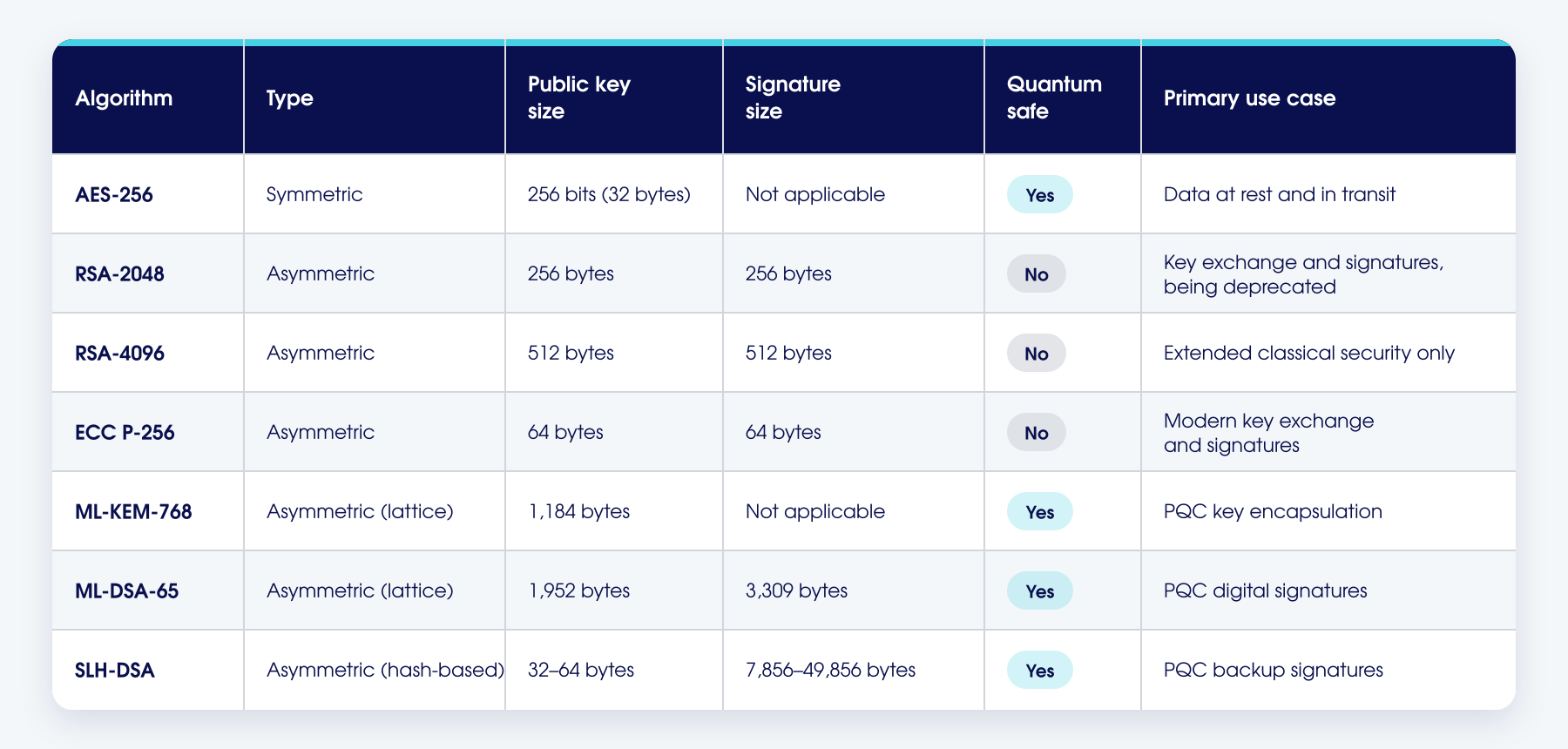
Note: AES-256 remains quantum-safe because Grover's algorithm only halves its effective key strength (to 128 bits), which is still computationally infeasible to attack. The threat from quantum computing falls on asymmetric algorithms (RSA, ECC), not symmetric ones.
What the comparison shows
- AES-256 is quantum safe; RSA and ECC are not. Grover's algorithm halves the effective strength of a symmetric key, taking AES-256 to 128 bits of post-quantum security. That remains computationally infeasible to attack. Shor's algorithm breaks RSA and ECC outright, whatever the key size.
- RSA-4096 is not a post-quantum answer. Doubling the key length buys time against classical attacks only. A cryptographically relevant quantum computer breaks RSA regardless.
- Key sizes are not comparable across types. ECC P-256 uses a 64-byte public key and offers roughly the security of RSA-3072 at 384 bytes. A 32-byte symmetric key offers more than either. Comparing raw sizes between symmetric, classical asymmetric and post-quantum algorithms tells you nothing useful about strength.
- The post-quantum cost is in the payload, not the key. ML-DSA-65 public keys are roughly eight times the size of RSA-2048, and its signatures are thirteen times larger. SLH-DSA is more extreme again. This has direct consequences for certificate sizes, TLS handshake bandwidth and any protocol with packet size constraints — and it is the reason PQC migration is an infrastructure exercise rather than an algorithm swap.
- SLH-DSA exists as insurance. Its keys are small but its signatures are enormous, and it is slower than ML-DSA. What it provides is diversity: it is hash-based rather than lattice-based, so if a weakness is later found in lattice assumptions it does not share the same foundation.
- What this means in practice. Data encrypted with AES-256 today stays protected. The exposure sits in key exchange, digital signatures and identity — precisely the functions PKI depends on, which is why post-quantum readiness is a PKI problem before it is an encryption problem.
Key generation: where security begins
Keys must be generated using cryptographically strong random number generators. Predictable keys, even slightly predictable ones, undermine security entirely. If an attacker can narrow the possible key values from 2^256 to 2^40 through prediction, brute force becomes feasible.
Common generation failures include using system time as a random seed, relying on weak random number generators, generating keys on systems with insufficient entropy (newly booted virtual machines are a frequent culprit), and deriving keys from predictable passwords without proper key derivation functions.
Proper generation uses hardware random number generators or well-seeded cryptographic RNGs. For keys derived from passwords, key derivation functions such as PBKDF2, bcrypt or Argon2 stretch weak passwords into strong keys by adding computational cost that makes brute-force attacks against the password impractical.
Key storage and protection
How keys are stored and protected matters as much as how they are generated. Common storage failures include hardcoding keys in source code, storing them in configuration files without protection, keeping them on the same systems as the encrypted data, and leaving them in memory longer than necessary.
Hardware security modules provide the strongest available protection. HSMs are dedicated devices designed to generate, store and use cryptographic keys without ever exposing the key material. Even administrators cannot extract keys from a correctly configured HSM; they can only invoke authorised operations. HSMs are standard practice in government, defence and financial services deployments, and are increasingly a regulatory requirement rather than a recommendation.
For organisations not using HSMs, cloud key management services (AWS KMS, Azure Key Vault, Google Cloud KMS) offer comparable protection with lower operational overhead. The key remains in the provider's infrastructure and applications request cryptographic operations rather than accessing key material directly.
Our partnership with Cryptomathic extends this further with CrystalKey 360, which centralises key lifecycle management across applications, HSMs, cloud environments and key stores.
Key rotation and lifecycle management
Keys should not last forever. Regular rotation limits the damage from undetected compromise: if a key was stolen six months ago, data encrypted with a new key remains protected. Rotation also limits the volume of data encrypted under any single key, reducing that key's value to an attacker.
Lifecycle management covers generation, distribution, storage, use, rotation and destruction. Each stage presents its own problem. Distribution must use secure channels. Storage must prevent unauthorised access. Use must be logged. Rotation must not disrupt operations. Destruction must be complete and verifiable.
For asymmetric keys this lifecycle is managed through PKI — the certificates, certificate authorities and revocation mechanisms that bind keys to identities and govern their validity. Certificate lifecycle management automates the process at scale, ensuring certificates and the keys they carry are renewed before expiry, revoked when compromised, and governed consistently across the estate.
Encryption key security checklist
The following summarises the practices organisations should have in place. Gaps in any of these represent direct risk to the effectiveness of your encryption.
- Hardware random number generation. All keys generated using hardware RNG or properly seeded CSPRNGs, never from predictable sources.
- HSM storage for CA and signing keys. All Certificate Authority private keys and code signing keys held in hardware security modules, not software keystores.
- Automated key rotation. Rotation automated at defined intervals, not dependent on manual processes or calendar reminders.
- Separation of duties. No single individual can generate, access and use a key without oversight. Root CA key ceremonies follow multi-person control procedures.
- Audit logging. All key operations logged with immutable audit trails supporting forensic investigation and compliance reporting.
- Complete cryptographic inventory. A cryptographic bill of materials mapping where keys and certificates exist across the infrastructure. Our guide to building a cryptographic inventory covers where to start.
- Key destruction verification. Decommissioned keys destroyed through verified processes, not simply deleted from file systems where recovery may be possible.
- Incident response for key compromise. Documented procedures for suspected or confirmed compromise, covering immediate revocation, re-keying and notification.
The gap between strong algorithms and weak operations
The theoretical security margin of modern encryption creates a dangerous illusion. Organisations assume their data is protected because they use AES-256 or RSA-2048, while operational practice undermines that protection entirely.
Assessments frequently find keys stored in plain text, shared across multiple systems, never rotated, or accessible to far more people than necessary. These operational failures, not algorithm weaknesses, cause real-world encryption breaches.
The pressure is increasing. Public TLS certificate lifetimes fall to 47 days by 2029, and the adoption of zero trust architectures raises the volume of certificate-based identity in use. Organisations that cannot manage keys effectively at current volumes will not manage them at eight times the renewal frequency.
Post-quantum encryption: how quantum computing threatens current keys
The most significant emerging threat to key security comes from quantum computing. Current asymmetric algorithms derive their security from mathematical problems classical computers cannot solve efficiently: factoring large numbers for RSA, and discrete logarithms on elliptic curves for ECC. A sufficiently powerful quantum computer running Shor's algorithm could break both.
This does not mean all encryption becomes insecure. Symmetric algorithms like AES are far less affected. Grover's algorithm provides a quadratic speedup against symmetric keys, effectively halving key strength, so AES-256 would still offer 128 bits of post-quantum security. The threat concentrates on asymmetric cryptography: the key exchange, digital signatures and identity verification that PKI depends on.
NIST post-quantum standards
NIST published three post-quantum cryptography standards in 2024:
- ML-KEM (CRYSTALS-Kyber, FIPS 203) replaces RSA and ECDH for key encapsulation. ML-KEM-768 keys are approximately 1,184 bytes against 256 bytes for a typical RSA-2048 public key, with implications for network protocols, certificate sizes and bandwidth.
- ML-DSA (CRYSTALS-Dilithium, FIPS 204) replaces RSA and ECDSA for digital signatures. ML-DSA-65 public keys are 1,952 bytes and signatures are 3,309 bytes, considerably larger than their RSA or ECC equivalents.
- SLH-DSA (SPHINCS+, FIPS 205) provides a hash-based backup signature scheme, using a fundamentally different mathematical approach in case lattice-based assumptions are later found vulnerable.
What this means for key management
The transition will require organisations to update their key management infrastructure. HSMs must support the new algorithms and larger key sizes. Certificate management systems must handle larger certificates without performance degradation. Network infrastructure must accommodate increased bandwidth from larger key exchanges.
NIST has signalled deprecation of RSA and ECC from 2030, with full prohibition by 2035. Organisations should be assessing their cryptographic estate now, building crypto agility into their architecture and developing phased migration roadmaps. Our guides to the NIST PQC roadmap and preparing your PKI for quantum computing cover the transition in detail.
The harvest now, decrypt later threat makes this urgent for anyone handling data with long-term sensitivity. Adversaries intercepting encrypted traffic today may decrypt it once quantum capability arrives, which means organisations holding classified, medical, financial or intellectual property data should treat readiness as a current priority rather than a future one.
How Unsung supports encryption key security
Unsung specialises in the infrastructure that makes key management work: the PKI that manages asymmetric keys, the HSM deployments that protect critical key material, and the operational practices that keep keys secure throughout their lifecycle.
- PKI health checks assessing current key management practice against security best practice, identifying gaps that undermine your encryption.
- Certificate lifecycle management to automate issuance, renewal and revocation of the certificates carrying your asymmetric keys.
- Hardware security module design, deployment and integration to protect your most critical cryptographic material.
- Cryptographic bill of materials to map the full estate and identify where vulnerable algorithms or weak key management practices exist.
- PKI consultancy for organisations planning post-quantum migration, key management modernisation or cryptographic infrastructure redesign.
Our consultants hold SC and DV security clearance and work across government, defence, financial services and healthcare. Get in touch to discuss your key management requirements.
Frequently Asked Questions
What is the difference between symmetric and asymmetric encryption keys?
How long should an encryption key be?
What is an HSM and why does it matter for key security?
Will quantum computing break all encryption?
What is key rotation and how often should it happen?
What is a cryptographic bill of materials (CBOM)?
What is crypto agility?
How does key management relate to zero trust?