The Importance of Digital Trust: Why PKI Underpins It
Most organisations have strong security policies and a weak picture of their own cryptographic estate. Digital trust depends far more on the second than the first.
Digital trust is the confidence that customers, partners, regulators and employees place in an organisation's ability to protect data, verify identity and deliver services reliably. It extends beyond technical safeguards into transparency, ethical practice and how an organisation behaves when something goes wrong. But it rests on a technical foundation, and that foundation is cryptographic.
The distinction that matters is between claiming trust and demonstrating it. A privacy policy is a claim. A certificate that proves a server is what it says it is, signed by an authority the client already trusts, is a demonstration. Organisations that understand that difference build durable trust. Those that do not tend to discover the gap during an incident.
In short
- Digital trust is a business outcome. Cryptography is the mechanism that delivers it.
- Recognition is near-universal; resourcing is not. Very few organisations have made anyone accountable.
- UK breach data shows the damage is often done by the response, not the incident.
- Shortening certificate lifetimes and the post-quantum transition are both raising the bar within this planning cycle.
Digital trust and security: the essential partnership
Digital trust and digital security are related but not interchangeable. Security is what you implement. Trust is what others conclude as a result.
Security is the technical foundation — encryption, multi-factor authentication, access control, monitoring, patching. Without it, no amount of transparency or good intent protects anyone. Policies do not stop breaches.
Trust is the business outcome those controls enable: customer retention, regulatory confidence, partner willingness to integrate, and the ability to withstand an incident without losing the market's faith. Security without trust is cost. Trust without security is exposure. The two only produce value together.
The four properties trust depends on
Strip away the terminology and digital trust reduces to four properties. Each one is delivered cryptographically.
- Identity. Proof that a person, device or service is who it claims to be. Delivered by digital certificates issued by an authority both parties already trust.
- Integrity. Assurance that data has not been altered in transit or at rest. Delivered by digital signatures and hashing.
- Confidentiality. Assurance that only the intended recipient can read the data. Delivered by encryption.
- Non-repudiation. Evidence that an action took place and who took it. Delivered by signatures bound to a verified identity.
Public Key Infrastructure is the framework that issues, manages and revokes the credentials underpinning all four. It is invisible when it works, which is exactly why it is under-managed — and highly visible when it does not. If PKI is unfamiliar territory, our PKI 101 guide covers the fundamentals, and everyday examples of PKI in action shows where it already operates in your organisation.
Where digital trust stands today
Organisations understand that digital trust matters. Almost none have made anyone responsible for it.
ISACA's State of Digital Trust research found that virtually all business and IT professionals surveyed regard digital trust as important, yet only around one in eight said their organisation had a dedicated staff role for it. Looking ahead, 82% expected digital trust to become more important within five years, while 28% thought their organisation would have a senior role dedicated to it by then.
The obstacles ISACA identified are consistent year on year: lack of leadership buy-in, skills shortages and insufficient budget. None of those are technical problems. They are governance problems, and they explain why organisations with sophisticated security tooling still suffer avoidable trust failures.
The commercial case
Digital trust is usually argued defensively, as a way of avoiding fines and incidents. The evidence suggests it also correlates with growth.
McKinsey's research on digital trust, based on a survey of more than 1,300 business leaders, found that organisations it classed as digital trust leaders were around 1.6 times more likely than the global average to record revenue and EBIT growth of at least 10%. Those same organisations were also less likely to have suffered a data breach in the preceding three years — 49% against 57% of everyone else.
Correlation is not causation. Organisations that manage cryptographic risk well tend to be well run in other respects. But it does undermine the position that trust investment is purely a cost centre with no return.
The UK picture
Research published by the Information Commissioner's Office in October 2024 found that 55% of UK adults have had personal data lost or stolen — close to 30 million people. Of those affected, 30% experienced emotional distress. A quarter received no support at all from the organisation responsible, and almost a third found out through the media rather than being told directly. The research was conducted by Savanta among 5,533 UK adults, with fieldwork in January and February 2024.
Those last two figures matter more than the headline. They are not measures of technical failure. They measure organisational behaviour after a breach — and that behaviour does more lasting damage to trust than the incident itself. An organisation that detects a problem, tells people promptly and supports them afterwards can retain confidence. One that lets customers learn about it from a news report generally cannot.
The wider threat environment compounds this. Phishing remains the dominant attack type, AI-assisted social engineering is lowering the skill required to run convincing campaigns, and the UK government's Cyber Security Breaches Survey continues to show breaches as routine rather than exceptional, with medium and large organisations the most frequently affected.
The business impact of trust erosion
The cost of losing digital trust arrives in several forms, most of which never appear on an incident response invoice.
Regulatory exposure
In its 2024/25 reporting year the ICO issued £4.4 million in fines, down from £15.6 million the year before, having received 12,412 personal data breach reports. Around 3% led to a formal investigation; most were resolved through informal action.
A falling fine total does not mean falling risk. The ICO is increasingly using reprimands and enforcement notices rather than financial penalties, particularly in the public sector. The reputational, operational and customer costs of a breach land regardless of whether a fine follows — and unlike a fine, they are not a one-off, quantifiable amount.
Reputational and commercial damage
Customer churn accelerates after a visible failure, and acquisition costs rise as prospects choose alternatives perceived as safer. This effect persists well beyond the news cycle, because the association between a brand and a breach is durable. Recovery is measured in years, not quarters.
Investor and partner confidence
Public companies routinely see share price movement following disclosure of a major incident. Private organisations face increased scrutiny from lenders, insurers and acquirers. More immediately, enterprise customers now assess cryptographic and certificate governance during procurement — a weak answer costs contracts before any incident occurs.
Supply chain propagation
Modern business relationships are interdependent. A trust failure at one organisation creates obligations and scrutiny across every partner connected to it. If your certificates authenticate connections into a customer's environment, your governance is their risk.
Building digital security as the foundation of trust
Effective digital trust rests on infrastructure that holds up under examination, not on stated intent.
Core technical controls
- Encryption at rest and in transit, using current algorithms and key lengths, applied consistently rather than selectively.
- Multi-factor authentication across all privileged access, with certificate-based or hardware-backed factors where the assurance level demands it.
- Granular access control, limiting exposure of sensitive data to legitimate business need rather than organisational convenience.
- Continuous monitoring across endpoints, network and cloud, with alerting that reaches someone who can act on it.
- Key protection proportionate to what the keys secure. Where keys underpin a trust hierarchy, hardware security modules provide the assurance that software key stores cannot.
PKI as the cryptographic foundation
PKI provides the machinery for secure digital identity, qualified electronic signatures and trusted timestamping. It is what allows two parties who have never interacted to establish trust automatically, in milliseconds, billions of times a day.
Where PKI is well designed, it is unremarkable. Where it is not, the symptoms are familiar: certificates issued outside any central process, hierarchies extended far beyond their original purpose, root CAs on hardware nobody wants to touch, undocumented key ceremonies, and recovery procedures that have never been tested.
In the cryptographic estates we assess, trust failures rarely begin with a sophisticated attack. They begin with a certificate nobody owned, issued for a short-term project that became production, with a renewal reminder going to a mailbox nobody reads. The service fails publicly, at the worst possible moment. We have covered the real cost of expired certificates separately.
Zero Trust depends on verifiable identity
Zero Trust architecture assumes no implicit trust based on network location. Every request is authenticated and authorised, every time, regardless of origin.
That model only functions if identity can be proven cryptographically. Passwords and network position are precisely the signals Zero Trust exists to stop relying on. Certificates issued to devices, workloads and users from a managed hierarchy are what replaces them.
Organisations frequently buy Zero Trust tooling before their certificate estate can support it, leaving a policy engine making decisions about identities it cannot properly validate. We have written about the role of PKI in Zero Trust strategies in more detail.
Detection and response
AI and machine learning have materially improved threat detection, analysing traffic, behaviour and log data at a volume no human team could review. Behavioural analytics identify anomalies that signature-based tools miss, and automated response can isolate an affected system within seconds.
Two caveats are worth stating. First, detection systems rely on the integrity of the data they consume — if logs cannot be attributed to a verified identity, the analysis is built on unreliable ground. Second, AI systems used in security decisions need oversight for bias and explainability, particularly where outcomes affect individuals. Ethical AI is a digital trust question, not a separate one.
Frameworks, standards and regulation
Standards do not create trust on their own, but they provide a defensible structure and an external check on internal assumptions.
- ISO 27001 — the recognised standard for information security management systems, covering governance, risk management and continuous improvement as well as technical controls. Independent certification demonstrates systematic commitment rather than stated intent.
- NCSC Cyber Assessment Framework — used across UK critical national infrastructure and by sector regulators to assess organisations designated under the NIS Regulations. Outcome-based rather than prescriptive.
- UK GDPR and equivalent regimes — establish requirements for collection, processing, storage and deletion, with defined individual rights. Privacy-by-design is an expectation, not an aspiration.
- eIDAS 2.0 — extends the European framework into digital identity wallets and qualified trust services, raising the bar for electronic signatures and authentication across member states.
- Sector-specific requirements — including healthcare, financial services, defence and transport frameworks, each reflecting a distinct threat landscape and assurance expectation.
Compliance and trust are not the same thing. Certification proves a system was assessed against a standard at a point in time. Trust requires that the controls still hold today. The gap between the two is where most organisations are exposed, and it is usually widest in the cryptographic estate, because certificates change constantly while audits happen annually.
The four pillars of digital trust implementation
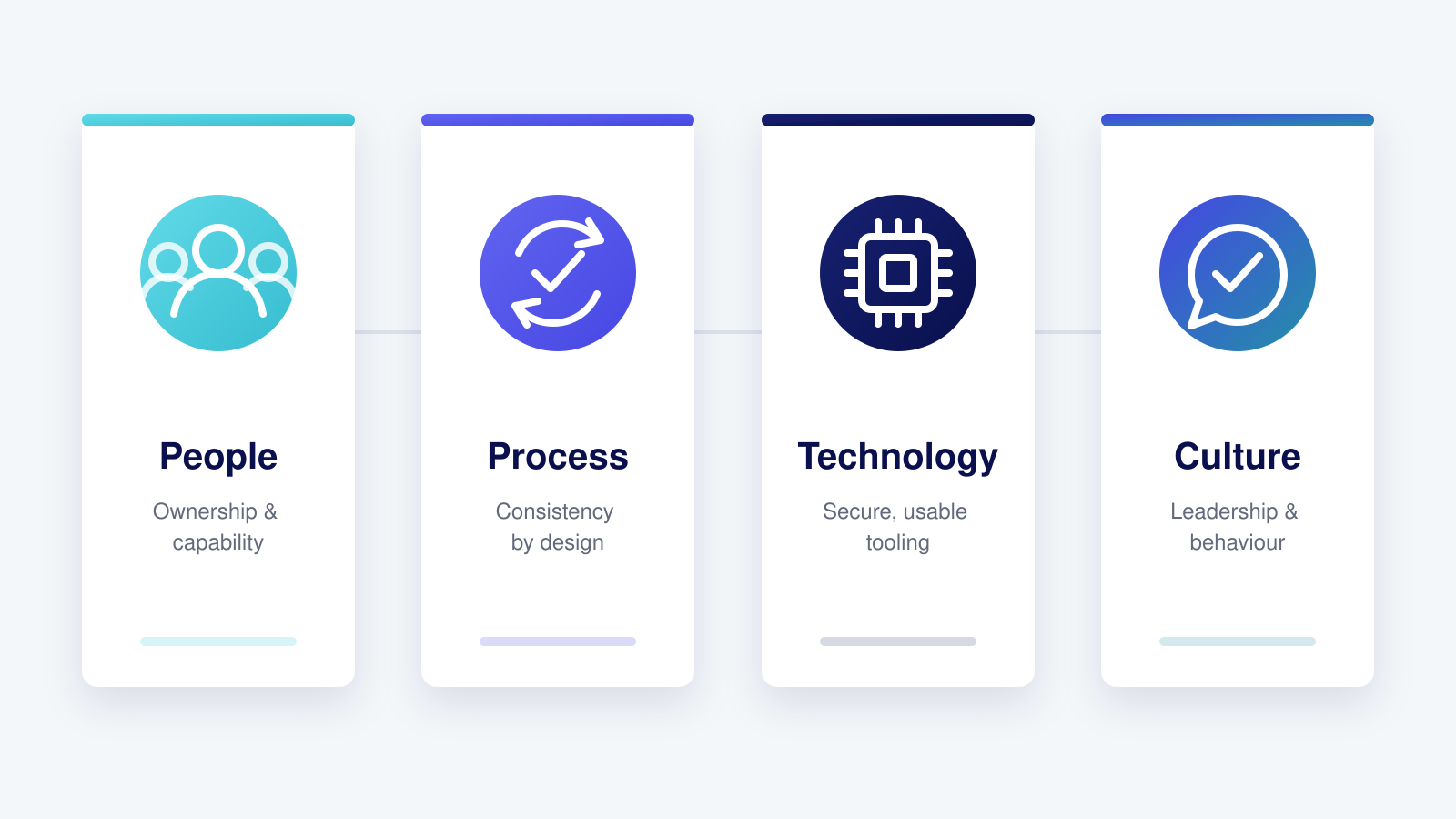
Sustainable digital trust rests on people, process, technology and culture. Weakness in any one undermines the others.
People
The most sophisticated technology cannot compensate for unclear responsibilities or inadequate awareness. Effective programmes provide role-specific training rather than generic annual modules, ensure executives can exercise informed oversight, and — critically — assign named ownership. Most trust failures we encounter trace back to something nobody was responsible for.
Process
Standardised, documented processes ensure consistent application regardless of staffing changes or operational pressure. Security and privacy considerations need to be built into design rather than reviewed at the end. Processes that depend on a single person's knowledge are not processes; they are risks with a job title attached.
Technology
Tooling must support business objectives while protecting sensitive data and staying out of users' way. Where protective measures create friction, people work around them, and the workaround becomes the real process. Selection should account for integration with existing infrastructure and for the operational burden of running the platform, not just its feature list.
Culture
Cultural change is the hardest element and the one most often skipped. It requires sustained leadership commitment, consistent reinforcement through policy and incentive, and recognition for the people who raise problems early. It takes years. It is also what determines how an organisation behaves in the first hour of an incident, which is when trust is won or lost.
Security and data protection in practice
- Endpoint protection, device encryption and mobile device management covering every device that touches organisational data.
- Network segmentation limiting lateral movement and reducing the blast radius of any single compromise.
- Encryption key management and certificate lifecycle processes that are actively operated, not assumed.
- Backup and disaster recovery procedures that are tested rather than documented, including recovery of the PKI itself.
- Security awareness training tailored to role, refreshed as threats change.
Privacy and data integrity
- Privacy-by-design applied at architecture stage, not retrofitted after launch.
- Data governance covering the full lifecycle from collection through deletion, with clear accountability at each stage.
- Audit trails and data lineage sufficient to answer regulatory questions without a manual evidence-gathering exercise.
- Cryptographic signing where the integrity of a record needs to be provable rather than asserted.
Transparency and user experience
- Privacy policies written to be understood, not only to be legally complete.
- Meaningful, accessible controls over data and privacy settings.
- Interfaces where security is present but not obstructive — users should not experience protection as an obstacle.
- Proactive communication about incidents and security changes. The ICO data on how people learn about breaches makes the case on its own.
Common challenges and how to address them
No executive sponsor or dedicated budget
Digital trust initiatives require sustained investment across multiple cycles. Building support means framing the case in business terms — competitive risk, contract eligibility, regulatory exposure — with specific metrics and timelines rather than generalised threat narratives.
Skills gaps
Cryptographic expertise is scarce and expensive to build in-house, particularly for organisations where PKI is a small part of a broader estate. The realistic options are targeted training for the parts you operate daily and external specialists for design, assessment and migration work.
Misalignment between teams
IT, security, privacy and business teams operate on different priorities and success measures. Shared objectives and joint planning help, but the more effective intervention is usually a single accountable owner for the cryptographic estate — because certificates cross every team boundary and belong to none of them by default.
Competing priorities and resource constraints
Phased implementation delivering early, visible value builds the credibility needed for larger investment. Discovery is the natural starting point: it is inexpensive, it produces an immediate and often uncomfortable picture, and it makes the subsequent business case self-evident.
Measuring and maintaining digital trust
What gets measured gets funded. Digital trust metrics should span technical effectiveness and business outcome.
- Coverage. Proportion of the certificate and key estate under active management, and the number of assets with no identified owner.
- Reliability. Certificate-related incidents over a rolling period, mean time to detect and resolve, and renewal success rate.
- Compliance. Audit findings, time to produce evidence on request, and open remediation actions.
- Customer. Retention, acquisition cost, and direct feedback on privacy and security confidence.
- Assurance. Results of independent testing and third-party assessment.
Independent validation matters more than internal reporting. Penetration testing and external assessment surface issues internal teams have stopped seeing, and they carry weight with boards, auditors and customers that self-assessment does not.
Continuous improvement
Threat landscapes, regulations and technology all move. Review cycles for policy, procedure and technical control should be scheduled rather than triggered by incidents. Lessons-learned processes need to focus on root cause rather than blame, or reporting quietly stops. And training has to evolve — a programme unchanged for three years is a compliance artefact, not a capability.
What is changing, and why it matters now
Two shifts are moving digital trust from a strategic topic to an operational deadline.
Certificate lifetimes are shortening
Public TLS certificate lifetimes are falling to 47 days. An annual renewal cycle becomes roughly eight cycles a year, on every affected certificate.
For organisations already automating, this is manageable. For those running manual processes and spreadsheets, it multiplies an existing problem eightfold. Certificate lifecycle management stops being a maturity goal and becomes an operational requirement — and the margin for recovering from a missed renewal effectively disappears.
The cryptographic foundations are changing
A sufficiently capable quantum computer would break the public-key algorithms that current digital trust depends on. The transition to post-quantum cryptography is a multi-year business transformation, not an algorithm swap.
Data with a long confidentiality requirement is already exposed. Encrypted traffic captured today can be stored and decrypted later — the harvest-now-decrypt-later problem. For organisations holding health records, legal files, national security material or long-lived intellectual property, the clock is already running regardless of when a capable machine arrives.
Four things worth starting now:
- Build a cryptographic inventory covering algorithms, key lengths and protocols — not just certificate expiry dates.
- Identify data with a confidentiality requirement extending beyond ten years.
- Add crypto-agility requirements to procurement so new systems can be updated in the field.
- Identify systems that cannot be updated, and plan replacement on a normal refresh cycle rather than an emergency one.
Crypto-agility is what turns the next cryptographic change into a managed programme rather than a rebuild. It is also what makes the 47-day transition survivable, which is why the two should be planned together rather than sequentially.
Emerging technologies and emerging threats
Distributed ledger technologies offer tamper-evident record keeping and decentralised identity models with genuine application in high-transparency contexts. Biometric authentication improves both security and convenience where the biometric data itself is properly protected. Both are useful. Neither removes the need for a managed trust hierarchy underneath.
On the threat side, synthetic media and AI-generated content are eroding the assumption that what you see and hear can be believed. Cryptographic content provenance — signing content at the point of capture so its origin can be verified — is one of the few responses that scales. IoT and operational technology expand the estate further, often with devices that cannot support modern protocols and cannot be replaced on a security timescale.
Getting started
A workable programme has four stages, in order. Taking them out of sequence is the most common reason initiatives stall.
1. Know what you have
A complete inventory of certificates, keys, algorithms and trust anchors across on-premises, cloud and operational technology, with named owners, updated continuously rather than compiled once. Most organisations discover more than they expected, and the gap between the spreadsheet and reality is usually the business case.
2. Know whether it is fit for purpose
An assessment of the PKI hierarchy, key protection, revocation infrastructure and operational procedures against how the estate is used today, rather than how it was designed to be used. A PKI health check establishes this baseline.
3. Make renewal reliable
Monitoring that flags problems before production, renewal workflows with enough lead time to retry, and tested revocation. Reliability before automation — automating an unreliable process simply scales the unreliability.
4. Automate
Issuance, renewal, deployment and revocation without manual intervention, policy enforced consistently, and a complete audit trail. This is what makes the estate sustainable at 47-day lifetimes and what produces the evidence auditors and regulators ask for.
The most common mistake is starting at step four. Automating an estate you cannot fully see automates the portion you already had under control. The certificates that cause outages are the ones nobody knew about.
How Unsung helps
We are a UK-based consultancy working exclusively on PKI and cryptographic infrastructure. We are vendor-neutral and we do not resell on commission, so our recommendations follow your requirements rather than a margin.
Our work with government and enterprise clients typically covers:
- PKI health checks — establishing what is genuinely deployed, what is at risk and what needs attention first.
- PKI consultancy — architecture, policy, governance and operating models.
- Certificate lifecycle management — platform selection, implementation and migration from manual processes.
- Hardware security modules — key protection proportionate to the assurance level required.
- Cryptographic bill of materials — the inventory that makes post-quantum planning possible.
Our consultants hold SC and DV clearance and deliver across central government, defence, financial services, healthcare and transport, in environments where disruption is not an acceptable outcome.
Digital trust is not a policy statement. It is a set of cryptographic controls that either hold up under examination or do not. Most organisations have never examined them — and the two changes now under way, shorter certificate lifetimes and the post-quantum transition, will examine them whether or not anyone chooses to.
Frequently Asked Questions
What is digital trust?
Why does digital trust matter for business?
What are the key pillars of digital trust?
What emerging threats challenge digital trust?